
Interview with Matthew Kirk
There is Freedom Within
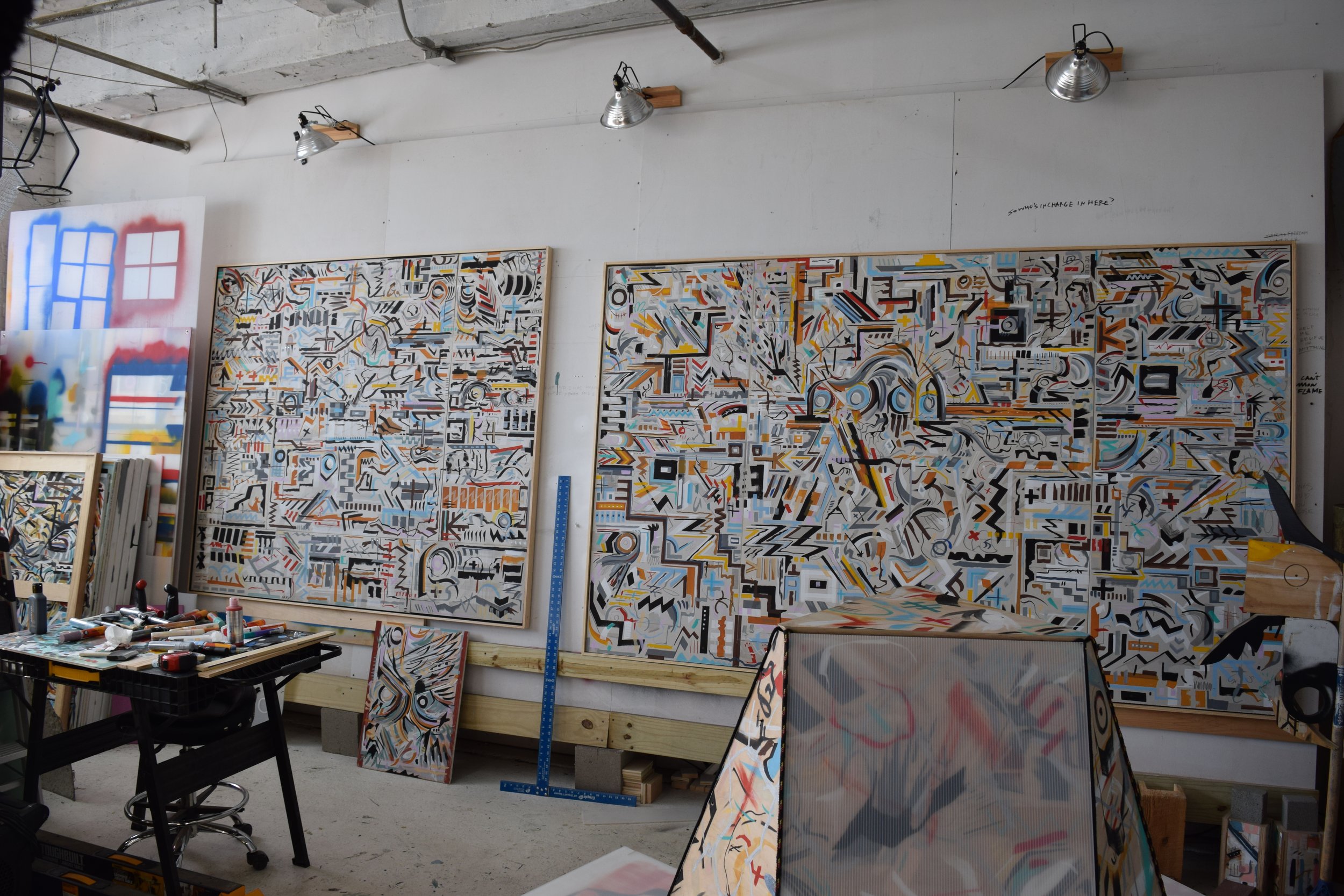
A conversation between Matthew Kirk and Stavroula Coulianidis
SC: Can you talk about these new paintings in the studio?
MK: Sure. So, there is different bodies of work. These paintings I came back to after a while of doing the weavings or the tile pieces that you might have seen before. But this was a series that when I first started, I was doing everything on paper. I don't really like canvas as much, although I have some that I'm working through. These works are on sheet rock, which is a gypsum panel and it's covered in paper, so it's like a paper panel. I just use that and go with it. It’s easy to buy and not super expensive. So it doesn't feel like, oh, ‘I spent all this time preparing this canvas’. It allows me to make my vision happen.
I also like it because it's dimensional and it's really easy to make. For example, this one is a 48-inch piece, and then there's this 12-inch piece that I cut. It’s easy to piece things together, which is something that I started doing recently. I had taken a little bit of a break from making these paintings to do all these tile pieces, pieces that get put together into bigger parts. But this is really fun. I like this a lot, but it's a different kind of creating, whereas I can just sit and feel what's happening.
SC: What is your process exactly? In this work for example, it feels automatic in a way. Is it dependent on each tile as to when you begin?
MK: How it usually starts is with a ‘seed painting’. Normally that is a smaller piece where I sort of get a feeling of how I'm going to be moving around the surface. I also test out the viscosity of some of the acrylic gouache paints. I don't mix anything really. I usually just test them out to see how it feels. Then I start with maybe a couple of little lines that I could maybe paint over later. You can kind of see here, there's like some very thin lines, and that will give me space to work around to it.
Once I have an idea of what might be happening, then it's all very intuitive, ‘well now I'm gonna use this color’. ‘I'm gonna just keep working with one color, maybe another color’ and seeing how that balances. Sometimes, I'll switch the panels to see if it's balanced, but then if you switch the panels and realize, ‘no it's really heavy with black’ or ‘it's really heavy with this white.’
When I do that, I can create a repetition or I can pull some of these shapes over onto this side, you know what I mean? I can start to blend things together to see if maybe they're supposed to be flipped around. But that doesn't always happen.
It has happened before where I'm like, ‘that's weird that I started this’, ‘this part fits so much better on this side’. I just continue going from whatever's happening in this area and pulling it across and then pulling the other side across so that it feels balanced. I want it to feel balanced where somebody doesn't walk in and go like, ‘why is it so heavy on one side?’
SC: Is it difficult to make it feel balanced?
MK: Yeah, but it's not difficult when the tiles come apart and move around. That’s another reason why I work like this. I had a photographer come over and had my youngest son help me move things around. He was 11. You know, ‘get off the iPad and come over here’. It was all fine, but a painting was on the cart and something got bumped and tipped over. The next thing you know, the cart started to fall. And so this section was a whole different piece. It all happened so fast. He was scared, he was upset and the photographer was there. It was such a nightmare. The whole top corner was demolished. So then, I set the work aside for a month or two, and then I thought that part of the reason I like being able to work with this medium is because, even though it is fragile, drywall is surrounding most of our lives. So, if I'm going to be making something that's in panels and if something gets damaged and I still have time to work on it or fix it, then why is it any different than if this is a smaller panel?
SC: I think that speaks to your savviness, especially being self-taught. Having the ability to find found material and being able to reuse that material in completely different ways. I feel like that kind of intertwines with this idea of, if something happens or if something is damaged. It can be like reborn again in a way.
MK: Absolutely. I’ve been to all the conservator studios and we see people re-weaving strands of canvas. If people can do that, then I can at least do this because this hasn’t gone anywhere yet, you know? I'll treat it like it’s still part of a painting. Honestly, to be able to have my son come back and to show him the new piece. Because he was so upset. I told him, ‘you know, accidents happen and look I can fix it.’ Now the piece is cooler to me in a way. It's got this story behind it.
Nobody else needs to know what happened because nobody else is going to ask questions about, ‘why are these like this?’ It's like, ‘I don't know. Because that's how I made it’. The abstraction and the meaning is all based on that feeling of balance and sometimes it starts with a only bright color or a dark color. Then its spending time feeling like, well, ‘I've been working on this side for a little bit. Maybe I'll go on that side and sort of see what's happening. What's happening over here in response to the other side.’
SC: Would you consider your work spiritual?
MK: I think so because it's free flowing. This particular painting for me would probably be the most spiritual. It's capturing whatever was happening to me in that moment, on that particular day. I don't keep any kind of log of what I did, because I don't think it would be possible really. Although it might be cool, to stop motion, like the way that the space gets filled. But I don't think that would need to happen. I think some days I'm looking at them and then just make little, tiny adjustments. Or not do anything at all. Sometimes I come over here at night, I walk my dog over and I come in here to look at them for a little bit again. For example, this chair, I’m lying in bed at night sometimes, and I'm thinking, how am I going to resolve this piece? I tried making like extra plastic parts to fit on it but this is how it feels and it feels right to me now. But then I'm still like, ‘but what am I going to do up here?’ It's sort of the same thing with being able to look at the paintings and to take them in. And when I get back in the morning, I can be like, ‘I’m going to go in with some chalk or add something else.’ Because I don't want it to be so heavy with just ink or paint, you know? So I think it is spiritual in that sense. It's something that I'm getting better at describing, but I also don't know where it comes from.
I don't know where that desire for ‘liking’ comes from, having it feel balanced or feeling like I want people to be able to see it and feel the work in a way that I feel about it, if that makes sense. It's this weird communication that I'm still trying to put words to.
SC: Do you feel like your work is a reflection of your upbringing? Did you grow up in a Native community?
MK: I grew up and was born in Arizona. My mom was from Wisconsin and went to Arizona for a nursing program. She worked in the hospital so she could get her student loans repaid, by working in a place of need. She chose the reservation and met my dad. They came from totally different cultures. I'm sure it was fun for a little while, but the reality was different. At one point, they did get remarried. He moved and lived with us in Wisconsin for a while. They remarried and had my brother. Then they got re-divorced and my dad moved back to Arizona.
I was the only child until my dad moved in with us, and then my brother was born. I was the only Native person I knew. But my mom never tried to hide that from me, she was very open about everything. The Forge Project was interesting to me. I didn't know anyone else and I didn't feel like I knew how to know anyone else, but I knew that I was making, my paintings and drawings and everything, always read as Native or there was something there.
I mean, especially with my dad, I had been out to visit with him a couple times, but I never really felt like I understood any of it. If anything, it helped me understand where he came from. There is this part of me that doesn't want to question it too much because it is what it is. It comes from some part of me.
SC: Maybe it is subconscious.
MK: Yeah, exactly.
SC: There are a lot of intense mark-making and these repetitive images represented in your work. Owl eyes keep reappearing.
MK: I know. I agree. None of it is planned at all. So, it's like, well, ‘how did this happen?’ It's almost something that comes out of me. There's something about what's happening when I'm doing this. The more I would try to figure out why, I also didn’t want to because if I started to get too deep into it, what if I can't do it anymore? And then what would I do? I don't want to mess with it.
SC: Would you call yourself a Native artist then?
MK: Yeah.
SC: What do you think about that?
MK: Well, I'm a Native person. I'm a Native artist. I'm an artist. I'm Native. I can’t claim to talk about any of these works as a reflection of – ‘here's the history behind where this comes from’ because that wouldn't matter in my work. At the same time, I guess that can be a label. I'm not against the label or anything, but this is contemporary painting, You know what I mean? I feel like I have more experience with contemporary painting from my time living in New York than I do to the backstory of where my history might come from, you know, my dad's side. But I think that's what is fun about it.
There’s plenty of other people that are living on the reservation or grew up with a close connection to their Native side or the Native world. I always feel as though I'm hugging the edges and watching or seeing other people do it. It’s kind of like when I watch people dancing. I'm like, that looks fun and I can do that myself, but I don't want to, I don't think I can do that in front of all these people right now. Like that kind of thing. And so, I definitely like to be included with other Native people that are coming up right now or getting recognition.
I'm grateful and honored to be part of that conversation, but it wouldn't be accurate for me to be like, ‘based on a story that you know my grandma told me’, I have a small family so whether or not I'm referencing my history on purpose, I can only draw back to a very small nucleus of people. When I go and see my dad, we'll go around and he'll be like, ‘we're going go see your uncles and your cousins and your aunt.’ Versus on my mom's side, I have two aunts and two uncles, that kind of thing. You know? You were saying you're Greek, you have a big family.
SC: Yes, you have to see everyone in the family.
MK: Yeah, exactly.
SC: I feel like you associate you're work as being in your own world in a way. You're in the contemporary conversation, but you're also making work on your own accord.
MK: Right. You know, it makes it hard to sort of plan for a show where I see some people, and there’s this theme or story or this kind of thing. I don't ever approach it like that. I'm just like, you know, this work is all going to leave on Friday, and then I'm going to start trying to resolve some of those canvases that I've been putting off because I don't have any space.
Another thing that I think about a lot of the time is the clock is ticking. Somebody once said to me, ‘you're a man and you should always be productive. You should always be doing something. You can't sit still’. I don't think that is the case. First of all, I am not sure about that whole, ‘I'm a man’ thing. If you're that way, I understand, but also that's not a thing. It's like, there's this drive of waking up and wanting to just work on this thing that makes me really happy.
The more I can do that, the more I can take that contentment or that whatever that feeling is that I get and bring into my home life, into being around my family, you know, that kind of stuff.
SC: You're producing a lot of work at once. All of these works feel infinite in a way. It just keeps going. Each painting is its own world, and there's this idea of world building that shapes them. I feel this in your practice as a whole. It feels like this infinite production. Perhaps, this is one piece, but it feels like there could be five more pieces attached.
MK: Right, exactly. I mean, it's not just one piece. It's kind of how, like these two started where I had them mixed together for a little while and then put them back and forth and then decided on the final sizes. So, when I say that there's a seed painting, I can use that. I can use that and put a bunch of other panels around it. Really multiply. And then just keep working and building out and out. The idea is, later when I see them, once they're away from me for a while and I see them again, it's like, ‘oh, I remember that’. And that's where this idea came from, or that's where this kind of started, or that's when I was out of this color, and so I got this other color and that's why that color is now prevalent or that sort of thing.
Especially with the sheet rock paintings, it really feels like they come into instances where I'm at the edge. For a while I had the extra panels back here. I would pull one out and put it next to the other one and keep going. And even if it's just for an idea, because I can put that panel away when these go away, I can put that very sparse panel out, and I can still say, well now I'm going to do this. Or like, I remember where this was, I'm gonna start doing that now.
SC: Even the paint itself, it's to the literal edge of the canvas.
MK: Yeah, totally. To the edge. And it can continue on. And part of it is the medium, being able to use something that's feels really flat, but in the flatness I can get so many different layers. With the canvases, I can do that. But then this painting here, this is an example of another panel. This is totally different.
SC: Yeah. Much more abstract.
MK: Way different energy. It's the kind of thing where I may keep this one for myself. I also can't work on this while I'm working another piece because they have different energies. If I'm using a wet gouache, what's the temptation to then take this color that doesn't exist or this kind of brush stroke that doesn't exist onto any of the other pieces. The second I do that it changes the whole thing – it’s not in balance. This abstract piece is an example of a seed painting. I did a larger one that went to Miami, and then I kept this one back and I've been working on it off and on and off again, but when this scales, it's going to be bonkers.
SC: Oh yeah. It has like a whole different feeling.
MK: Whole different feeling. At the same time, there's going to be parts that will feed into these other ones, even if its palette, composition or material is different. It's still going to inform. They'll all have a conversation between each other. This idea is exciting to me. To be able to let myself go, be totally free and not worry so much about all the different little compositions is exciting.
SC: These ideas reiterate the idea of balance in your work. You have areas of the canvas where the paint is a bit more focused on the details and areas where the paint is more fluidly applied. You need both to be able to create.
MK: Right. There’s a good chance that I make more like this work and then come back to something like this work anyway, right? What these all have is that you can see the background color of the panel. So these all have this weird sort of reverence for the base color. That's why I like using those colored sheet rocks as well because I'm not going to paint a whole panel that green, blue or lavender. There is something about neutral color. If I get canvas, it's bright white. I can just hit the ground running.
It's exciting. When I'm getting blocked with paintings, I can build these weird sculptures that I enjoy and be like, this is a whole different way to use my brain. Or to measure and cut these sculptures to make with the basketball hoops. There's gotta be a reason that I keep finding basketball hoops and must use them for something. I don't have any space to play basketball, but I love the way that they can act like a stretcher. I love the way that they're draped as well. Totally sculptural.
SC: Many contemporary artists use basketball hoops in their work. For different reasons. There is this nativity to yours.
MK: Well, that's the other thing that’s hard. I try not to pay too much attention to everything else that's going on around me. I don't want to be another basketball hoop guy. But it's not the only basketball hoop I'm using. Being able to jump between works, like these constructions I make with all the cut off pieces of wood. Then once I have them put together, I treat that as the canvas. Being able to paint on those is exciting because it has this feeling as if everyone else can do whatever they want, and I’ll do what I want. You know what I mean? I don't have to be worried about having to have an explanation for ‘why’ is freeing.
SC: I look at these sculptures and think of Outsider artists like Thornton Dial or even Hawkins Bolden. Bolden used steel pots to make these scarecrow sculptures in his backyard.
MK: This is sculpture is actually going to be a bird feeder. I have these stacked up here right now because I didn't have anywhere else to put them, but the seeds are going to go in there. I want to make a base for it so it can go outside.
SC: That will be lovely.
MK: But to your reference, it really is reminiscent of a lot of self-taught, outsider artists because they're just making to make. They had no other outside influence for the most part. And they were creating what came to them using found materials or just ideas that came into their head. There was no rhyme or reason sometimes it was just, ‘I have to create’, ‘I have to make’, and ‘I have to do this.’
SC: Exactly. It reminds me of that a bit.
MK: I agree. And I think that the thing for me, I'll make it and I'll figure it out later. I'll figure out, ‘wait why did I do it this way?’ Or even being able to be like, I made this one first and then realize that in the process of making it, what I really wanted to make was this next piece. You know what I mean? So being able to have the freedom to just create something and not worry about it, is something that I think a lot of people spend money trying to learn or they learn how to do the creating part and then they have to unlearn so that they can speak about their work. It's kind of going up the hill just to be back at the bottom of the hill, right?
SC: A hundred percent.
MK: So for whatever reason, I consider myself very lucky that I was able to sort of figure that out and without too much debt!